

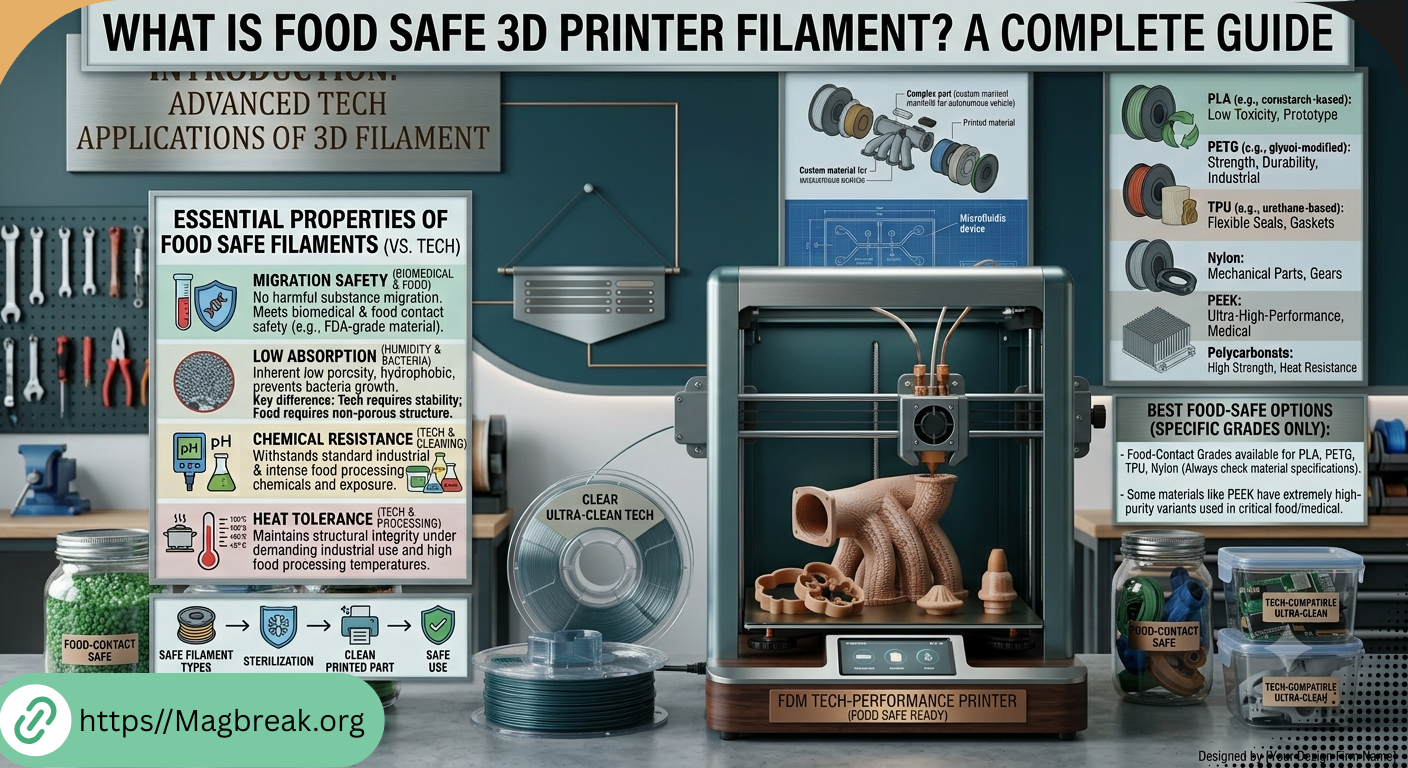
Quick Answer: Food safe 3D printer filament refers to materials like PLA, PETG, or specific certified filaments that are non toxic and safe for occasional contact with food. However, true food safety also depends on your printer setup, nozzle material, and finishing process, not the filament alone. Even certified food safe filament can become unsafe if printed with contaminated equipment.
What Does Food Safe Filament Actually Mean?
Food safe filament refers to 3D printing materials that meet certain safety standards for contact with food or beverages.
This usually means the raw material itself is non toxic and free from harmful additives. However, food safety in 3D printing is more complicated than just choosing the right filament, since the printing process itself introduces additional risks.
The tech team at Mag Break often sees beginners assume any filament labeled food safe automatically makes a finished print safe to eat from, which is not entirely accurate.
Which Filaments Are Considered Food Safe?
Several common filament types are generally recognized as safer options for food related projects.
PLA Filament
PLA is one of the most commonly used filaments and is derived from natural sources like corn starch. Many PLA filaments are certified food safe in their raw form, making them a popular starting choice.
PETG Filament
PETG is another widely used option, known for being more durable and moisture resistant than PLA. Several PETG filaments are also available with food safe certifications.
Specialty Certified Filaments
Some manufacturers produce filaments specifically certified under food contact safety standards, offering extra assurance beyond standard PLA or PETG options.
Why Is Filament Alone Not Enough For Food Safety?
Understanding this distinction is one of the most important parts of printing anything food related safely.
food safe 3d printer filament
Layer Lines Trap Bacteria
3D printed objects naturally have tiny ridges between layers, even when smooth to the touch. These grooves can trap bacteria and moisture, making thorough cleaning difficult over time. food safe 3d printer filament
food safe 3d printer filament
Nozzle Material Matters
Many standard 3D printer nozzles are made from brass, which can contain trace amounts of lead. Even with food safe filament, printing through a non food safe nozzle can introduce contamination.
How Can You Print Safely For Food Related Projects?
A few practical steps can significantly reduce risk when printing anything intended for food contact.
Use a stainless steel nozzle instead of standard brass ones, since stainless steel does not carry the same contamination risk. Keep printed items away from direct, prolonged food contact when possible, using them instead for short term or decorative purposes like cookie cutters used briefly rather than daily utensils.
The team at Mag Break generally recommends treating most home 3D printed items as food adjacent rather than fully food safe, unless specific certification and equipment precautions are followed carefully.
What Are Safer Alternatives To Direct Food Contact Prints?
For many hobbyists, avoiding direct food contact altogether is the safest and simplest approach.
Printing molds for chocolate or ice, rather than direct utensils, allows you to enjoy 3D printing creativity while keeping actual food contact minimal. Adding a food safe silicone liner inside printed molds is another popular workaround that avoids direct plastic to food contact entirely. food safe 3d printer filament.
Can You Make 3D Prints Fully Food Safe With Coatings?
Some makers use food safe epoxy coatings to seal printed surfaces, though this comes with its own considerations.
A proper food safe epoxy coating can smooth over layer lines and reduce bacteria buildup risk significantly. However, the coating must be specifically labeled food safe and applied correctly, since an improperly cured or non certified coating can introduce new safety concerns rather than solving the original ones.
food safe 3d printer filament.
What Should Beginners Avoid When Printing Food Related Items?
A few common mistakes can undermine food safety even when using proper filament.
Avoid using items for hot food or liquids unless the filament is specifically rated for that temperature range, since heat can cause warping or chemical leaching in unsuitable materials. Also avoid reusing the same printed item repeatedly for raw food preparation, since repeated exposure increases contamination risk over time.
food safe 3d printer filament.
Frequently Asked Questions
Here are quick answers to the most common questions about food safe 3D printer filament.
Is PLA filament actually safe for food contact? Many PLA filaments are certified food safe in raw form, but the printing process itself can introduce contamination risks beyond the material alone.
Is PLA filament actually safe for food contact?
Many PLA filaments are certified food safe in raw form, but the printing process itself can introduce contamination risks beyond the material alone.
Do I need a special nozzle for food safe printing?
Yes, a stainless steel nozzle is recommended over standard brass nozzles to avoid potential trace contamination.
Can 3D printed items be used for everyday eating utensils?
It is generally safer to use 3D printed items for short term or decorative food related purposes rather than daily eating utensils.
Does food safe filament mean the finished print is fully sterile?
No, layer lines in printed objects can trap bacteria, so proper cleaning and careful use remain important even with food safe filament.
Are food safe epoxy coatings a good solution?
Yes, when properly certified and applied, they can help smooth surfaces and reduce bacteria risk, but improper application can create new safety issues.
food safe 3d printer filament.
What is a safer alternative to direct food contact printing?
Printing molds for chocolate or ice, or using food safe silicone liners, allows creative use while minimizing direct food contact.
Conclusion
Food safe 3D printer filament is a great starting point, but true food safety depends on more than just the material you choose. Your nozzle, printing process, and how you use the finished item all play an equally important role.
By combining certified filament with proper equipment and sensible precautions, you can enjoy creative food related printing projects without unnecessary risk. As always, the team at Mag Break recommends staying cautious with direct food contact prints and opting for safer alternatives like molds or coated surfaces whenever possible.
- Why People Are Searching Zerohedge .com in 2026
- US-China Talks: 5 Shocking Things Before the Trump-Xi Summit
- Emerging Africa Halal Fund: What It Is and How It Works
- Emergent Fund: A Complete Guide to Saving the Right Amount
- TikTok Shop Affiliate Contract: The Complete 7-Point Guide